Brian R. Alexander

PURCHASE: POWELL'S BOOKS
PURCHASE: INDIE BOUND
PURCHASE: AMAZON.COM
PURCHASE: BARNES & NOBLE
Publisher: Current Hardcover
Publication Date: September 13, 2012
ISBN-10: 1591845130
ISBN-13: 978-1591845133

Visit thechemistrybetweenus.com

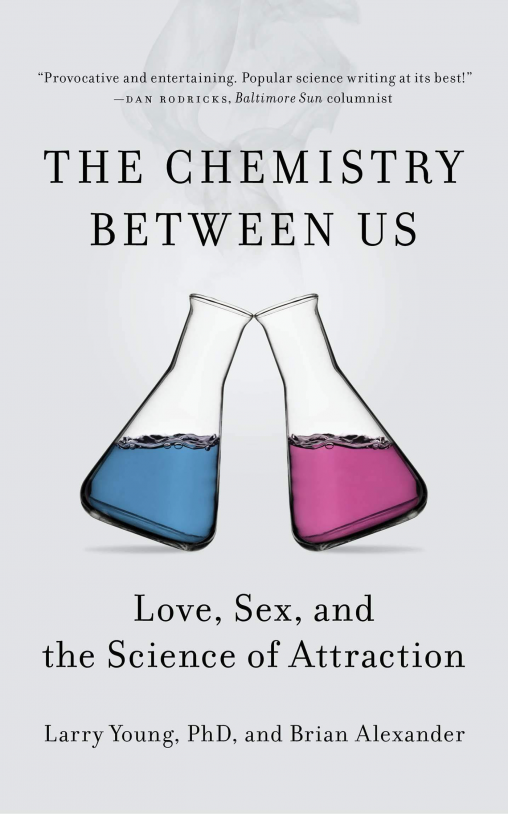
One of the world's leading social neuroscientists and an award-winning journalist team up to give readers a grand unified theory of what drives us to do the things we do when we do love, sex, and human bonding.

Provocative and entertaining. Popular science writing at its best!
Dan Rodricks
Baltimore Sun, WYPR Radio
Listen to the NPR interview

...One wild and entertaining ride. The prose in The Chemistry Between Us is lively and fun – and provides a fresh and unapologetically pointed analysis on what understanding the neurobiological correlates of love may mean for both our relationships and our culture.
Kayt Sukel
New Scientist Magazine

"Dr. Young is one of the science world's most respected authorities on the chemistry underlying the most complicated and beloved interactions of our species. The insight and candor he and Mr. Alexander provide in this simultaneously entertaining and compelling book will impress both novice and scientific aficionado alike. What an intellectually and emotionally satisfying exploration!"
Dr. Mayim Bialik, Ph.D, CLEC
Actress on CBS' The Big Bang Theory
Author of Beyond The Sling: How to Raise Confident Loving Children the Attachment Parenting Way

"Nothing fascinates us more than why we fall in love and what makes us choose that particular person. The Chemistry Between Us sheds light on just this mysterious phenomena with a thorough look at the neuroscience and psychology of the process. Whether you have a desire for better intellectual understanding or a personal curiosity as to why you or your partner do what you do, this book is a super enjoyable class in love, sex and all its dark mysteries. A fascinating and stimulating read!"
Gail Saltz M.D.
NBC Today Show contributor and Clinical Associate Professor of Psychiatry The New York Presbyterian Hospital

"This lively book by a great neuroscientist and a savvy science writer is the first popular account to tie together what we have learned about the chemistry of sex, love, and family bonds. Progress in this field has been nothing short of breath-taking, and Larry Young is recognized as its leading pioneer. The way our brains react when boy meets girl determines the stability of marriage and the future of the human family."
Frans de Waal
Author of The Age of Empathy

"If you've ever been curious — and let's face it, we all have — about the intricate dance of biology and behavior that both brings men and women together and pushes them apart, then The Chemistry Between Us is the book for you. Authors Larry Young and Brian Alexander explore questions as gentle as parenting and as edgy as sexual addiction with consistent style, humor, and insight. The result is a story that's fun, fascinating and, finally, insightful."
Deborah Blum
Pulitzer Prize winner, author of Sex on the Brain, Love at Goon Park, and The Poisoner's Handbook


PURCHASE: INDIE BOUND
PURCHASE: POWELL'S BOOKS
PURCHASE: RANODOM HOUSE
PURCHASE: AMAZON.COM
PURCHASE: BARNES & NOBLE
Publisher: Three Rivers Press
Publication Date: December 30, 2008
ISBN-10: 0307351335
ISBN-13: 978-0307351333

Visit americaunzipped.com

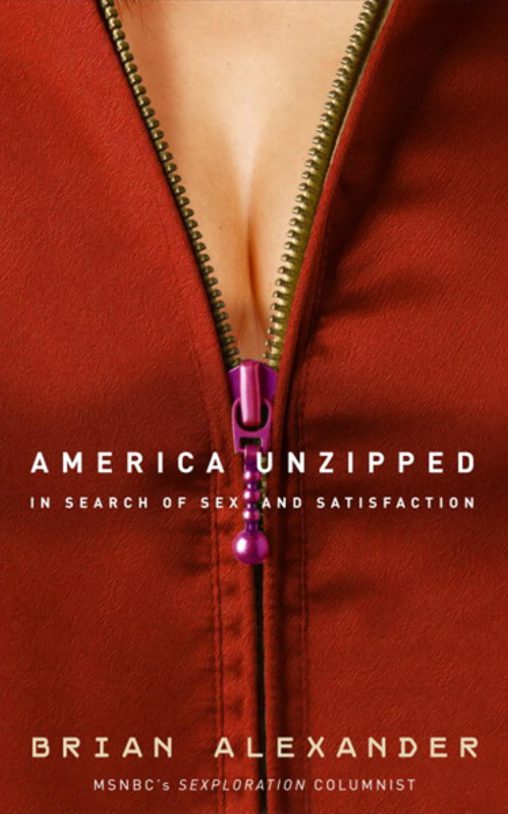
"A swift, smooth, contemplative and frequently hilarious travelogue through America's surprisingly mainstream nether regions."
Arthur Salm, Books Editor, San Diego Union-Tribune

"Scintillating. The author's thoughtful observations on the need for contact at all costs in an increasingly virtual society ring true."
The Washington Post

"For anyone curious about the state of sexuality in America, this smart, intriguing tour will scratch your (intellectual) itch."
Publisher's Weekly

"A clear-headed and open-minded look at the sexual revolution's final stage."
Kirkus Reviews

"Eye-openingly smart... Picking up where Sallie Tisdale's TALK DIRTY TO ME left off in the '90s, Brian Alexander's AMERICA UNZIPPED appreciatively unpacks our culture's last remaining sexual taboos. (Apparently, we've still got a few)."
Genevieve Field, co-founder of Nerve.com

"... with both humor and reflection, Alexander sees exhilarating liberation but also a kind of 'kitschy banalty': Where's the excitement when our thrills are no longer taboo?"
Matthew Hutson, Psychology Today

"[Alexander's] voice is sensible, humorous and largely unbiased, even when he is aghast."
Bookgasm.com

"Alexander himself is at least as interesting as the people he observed and interviewed...America Unzipped is entertaining. Alexander has a gift for narrative, and he' s not afraid to put himself in the story."
Houston Press


PURCASE: INDIE BOUND
PURCASE: POWELL'S BOOKS
PURCASE: PERSEUS BOOKS
PURCHASE: AMAZON.COM
PURCHASE: BARNES & NOBLE
Publisher: Basic Books
Publication Date: October 6, 2004
ISBN-10: 046500105X
ISBN-13: 978-0465001057

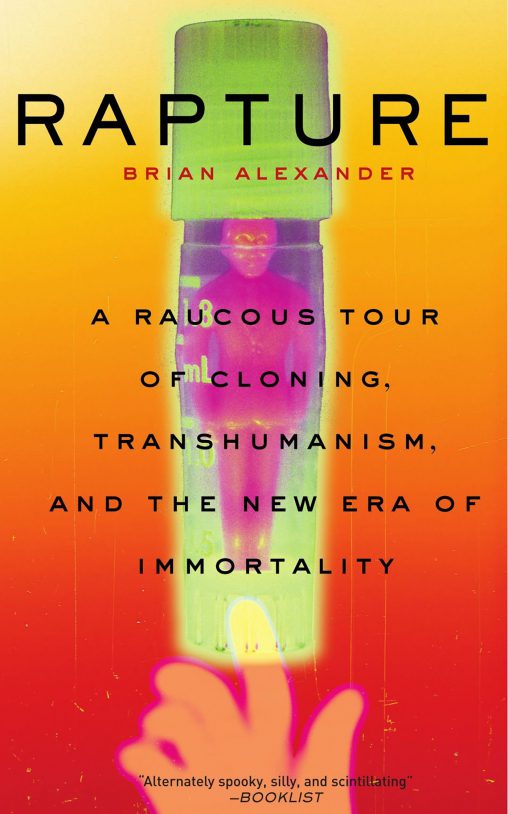
"Written for the lay reader, this exploration of the fringe science of biotechnology is alternately spooky, silly, and scintillating."
Booklist

"Though sympathetic to his subjects and their work, Alexander casts his tale in shades of gray rather than in black and white, and the result is a nuanced portrait of the intersection of idealism, capitalism, politics and science on the frontiers of biotechnology that will leave readers eager to see what the future might hold."
Publisher's Weekly

"Funny, bizarre, yet always fascinating."
Biology Digest

"Well-reported and dense with insight."
Psychology Today

"This interesting popular history of the trans-human movement is an important statement of an evolving debate in modern American society."
Roger D. Launius Curator, Planetary Exploration Programs, National Air and Space Museum

"Alexander has the same gonzo style, the same wicked humor and, most of all, that Mambo Chicken sensibility -- a combination of ironic detachment and sheer bafflement at the hubris of these over-the-edge scientists."
Carl Elliott, The American Prospect

"In Rapture: How Biotech Became the New Religion, journalist Brian Alexander provides a fascinating and funny travel guide through the cutting-edge world of genetic engineering."
James Pethokoukis, US News and World Report

"With RAPTURE, Alexander has become the voice of biotechnology for the 21st century."
Glenn McGee, author of BEYOND GENETICS

A Few Selections


The Awful Truth About Drugs in Sports
Outside Magazine

I keep waiting for Dr. Don Caitlin to sound thrilled, or at least mildly pleased, about the mushrooming furor over the use of performance-enhancing drugs in sports. Catlin, after all, helped break the now-infamous BALCO doping scandal from this very office, a small, dark, paper-strewn space inside the UCLA Olympic Analytical Laboratory. The lab is one of the world's top facilities for analyzing biological samples from athletes to detect the use of banned substances like anabolic steroids, the blood-oxygen booster erythropoetin (EPO), and scores of other prohibited drugs that aid performance.

But Catlin—a tall, balding, 67-year-old M.D. with a handsomely craggy face—just frowns when I prod him. He sips from an old coffee mug and says the current media blitz reminds him of every other time doping has hit the news: There's a lot of noise, and yet doping persists. He thinks about this a moment and then issues a bleak verdict on the drug-policing system in which he's toiled for the past 25 years.

"People are following this old model—run 'em down, chase 'em, find 'em, assume they are guilty, drag them into testing," he says. "And athletes still get away with stuff, and I maintain you can get away with stuff with everybody looking right at you."

Good Cop, Bad Cop
Outside Magazine

Since I already know Zach Lund's life story, I can't help it: The first thing I do when we meet is stare at his shiny bald head. He looks good bald, though he also looks more like an ordinary guy who works out than an Olympic athlete. He's fit, compact, and so unassuming that, as we stand around in his hotel room at the Hilton Universal City, gazing at the Hollywood Hills, he seems a little amazed to be here in the heart of showbiz.

Lund has spent the past ten hours smiling, talking, and emoting for NBC, which has been shooting profiles of athletes expected to make the U.S. Winter Olympic team in Vancouver. The day was fun but a struggle, too. Lund has overcome a lot to succeed, but he's mainly known for getting kicked out of the 2006 Winter Games in Turin, Italy, thanks to a drug-related suspension that he and many others believe was unfair. Inevitably, Turin is what everybody asks about, so, later that night when we sit down to dinner, he wants to make sure I understand his full story...

Big Fish
Outside Magazine

According to allegations that first surfaced in The Wall Street Journal, Armstrong and team director Johan Bruyneel introduced Landis to systematic doping within the old U.S. Postal Service squad, with Armstrong supposedly explaining how to transfuse blood packed with performance-boosting red blood cells.

And with that charge, an all-important figure entered the story: Jeff Novitzky, a six-foot-six, chrome-domed, gun-packing G-man who's an investigator with the U.S. Food and Drug Administration. The 43-year-old Novitzky, the man who famously broke the BALCO drug scandal, had already been looking into doping rumors surrounding a low-level Los Angeles–based cycling team called Rock Racing but quickly turned his attention to Armstrong once Landis started talking.

There's Something in the Water
Outside Magazine

Lutes shows us a few slides to help explain the concept of network marketing, the business model Evolv uses and another name for a system known as multilevel marketing (MLM). Over the years, economists and critics have warned against these financial arrangements, arguing that although they're legal in the United States, they're little more than elaborate pyramid schemes, likely to leave a raft of heartbroken optimists in their wake. Sineni mentioned this criticism to me earlier, dismissing it and calling Evolv not a pyramid but a "phenomenal structure." Now Lutes is explaining how it works.

"Two, four, six, eight, 16, 32, 64, 128, 256, 512, 1,024!" he says. "I know the math! If you brought in two people and they brought in two people," he continues, before long "you've got over 2,000 cases [of water] you are getting paid on, and how many people did you bring in? Two!"

Then he shows us a diagram of the structure, and it looks exactly like … well, let's just call it a ziggurat.

Special Report: The New Boys' Health Scare
Redbook Magazine

Scientists, regulatory organizations, and government groups are concerned that chemicals in everyday products may have launched an unintentional war on our health. Children may be most seriously affected because their developing brains and bodies are especially vulnerable to chemicals. Over the last few years, there has been a glut of new research about the possible effects on baby boys, in particular. Some research has suggested that EDCs can change the way male fetuses' brains form in the womb. Other studies have linked EDCs to a rise in genital birth defects such as hypospadias (in which the opening of the urethra develops on the shaft, not at the tip, of the penis) and cryptorchidism (undescended testicles, a risk factor for poor semen quality and testicular cancer). And although data from the United States is inconclusive, studies from across the globe suggest that adult male sperm quality and fertility are dropping.

Tour de Farce
Slate Magazine

Like much of the rest of the world, I was thrilled by Floyd Landis' startling comeback in Stage 17 of the Tour de France. But since I write about doping and sports, I've learned to be suspicious of miracles. The real tragedy of doping is the way it tarnishes everything and everybody and forbids us from giving in to the wonder of sports. And now the news comes out that Floyd Landis tested positive for high testosterone levels following that very same miracle stage. There is a disheartening feeling of inevitability about the whole thing.

Lies About Women's Health
Glamour

For the past 15 years, Ruth Shaber, M.D., has been an ob-gyn in San Francisco for Kaiser Permanente, one of the nation's largest health maintenance organizations. She sees all types of women—union members, executives, waitresses. Most of them, Dr. Shaber says, have questions for her, including how to protect themselves from sexually transmitted diseases, how to preserve their fertility, how to prevent breast and cervical cancer and whether the latest Internet health scare they've heard is really true.

Dr. Shaber tries hard to separate fact from fiction because, she says, "rumor and hearsay can start to seem real." In the past, she'd sometimes refer patients to government websites and printed fact sheets, or rely on those outlets to help create her own materials. Not anymore. "As a physician, I can no longer trust government sources," says Dr. Shaber. She is not a political activist or a conspiracy theorist; in addition to her own practice, she's Kaiser Permanente's director of women's health services for northern California and head of the HMO's Women's Health Research Institute. Yet this decidedly mainstream doctor and administrator says, "I no longer trust FDA decisions or materials generated [by the government]. Ten years ago, I would not have had to scrutinize government information. Now I don't feel comfortable giving it to my patients."

Such doctor mistrust represents a major change. For the past 100 years, the Food and Drug Administration (FDA) has been the world's premier government agency ensuring drug safety. The National Institutes of Health (NIH) and the Centers for Disease Control and Prevention (CDC) have similarly stellar track records. But recently, Dr. Shaber charges, the government has lost its most precious asset: credibility.

How did it happen? Many prominent figures in science and public health think they know the answer. "People believe that religiously based social conservatives have direct lines to the powers that be within the U.S. government, the administration, Congress, and are influencing public-health policy, practice and research in ways that are unprecedented and very dangerous," says Judith Auerbach, Ph.D., a former NIH official who is now a vice president at the nonprofit American Foundation for AIDS Research. In fact, Glamour, has found that on issues ranging from STDs to birth control, some radical conservative activists have used fudged and sometimes flatly false data to persuade the government to promote their agenda of abstinence until marriage.

A Drug's Promise (or Not) of Youth
The Los Angeles Times

I have traveled to the Palm Springs Life Extension Institute in search of Dr. Edmund Chein. Instead I find Tiffany Caranci. Tiffany is 20 years old and looks exactly how you might expect a 20-year-old named Tiffany to look: platform heels, low-slung skirt, hair streaked blond and black. She's brazenly sexy, and so very young.

I am a man and not very young. I have entered that disorienting neverland of middle age where you can't tell if women like Tiffany smile because you remind them of their fathers or because they think you're hot. I'm pretty sure Tiffany is smiling at me as I walk into Chein's clinic because she's a receptionist and gets paid to smile, but my ego scouts for any sign from her to justify the voice in my head that's saying: "You've still got it, brother." This neediness, of course, proves that I don't have it, and I don't mind admitting that right now I'd like it back. Well done, Tiffany.

I've come to meet the good doctor, but he is elusive, lying low on the advice of his lawyer.

(You)2
WIRED Magazine

In four hours, the Creator will ask me for $100,000 to help finance the cloning of a dead man. But by then, he'll have swallowed too much alcohol, driven us recklessly around the city in his sports car, and tried and failed to pick up a waitress. So I'll be accustomed to a little flamboyance from him, and his strange request will seem like ordinary conversation.

Right now, though, we're just starting dinner when he spells out his desire to be the first scientist in history to clone a human being. "This will be the biggest leap for mankind," he says. "It is the central core of Christianity, the resurrection of Jesus, the promise of eternal life!" The Creator, an intense, dark-haired man in his thirties, looks a little like Peter Lorre in The Beast With Five Fingers when he says this, so I have to remind myself that he's not a nut. He's a real scientist, a pretty good one, too, with a PhD in molecular biology, a list of peer-reviewed publications, and a research job at a big-name university. (Where, he says, he would be fired instantly if he went public with his human-cloning plans - hence his demand to remain anonymous.) The Creator conducts research on a protein that he was the first to identify, one that could have a tremendous impact on cardiovascular disease.

Tonight, he's not thinking about this work. Tonight, he's excited - thrilled, really - by the prospect of cloning a person. "This is the easiest thing you can do! You just get the damn nucleus, and put this damn nucleus into this enucleated oocyte, and pray to God something happens, and put it back into the surrogate mother, and wait. The easiest thing we could do right now, believe me, is to damn clone a human being!"

Free to Clone
The New York Times Magazine

This election year, the debate over cloning technology has become a circus -- and hardly anybody has noticed the gorilla hiding in the tent. Even while President Bush has endorsed throwing scientists in jail to stop ''reckless experiments'' (and has tried to muscle the U.N. into adopting a ban on all forms of cloning, even for research), it's just possible the First Amendment will protect researchers who want to perform cloning research.

An Elegy for Magazines
The Huffington Post

A good magazine is a combination of stories, photos, drawings, opinions, reporting, whimsy, humor. It is an art that is not reproducible nor replaceable by any other medium. At their best magazines are not "content," they are objets.

Yet they cost just a few bucks a piece. Imagine that. Imagine what you get for your money. You can travel to places you aren't likely to visit, meet people you are not likely to meet, learn about some topic you may never have wondered about but there you are, reading about it, because a magazine has delivered it to your eyes and packaged it in such a way that you wind up enlightened or amused or outraged. I have never, not even once, worn a formal gown. But the image of Lisa Fonssagrives in her black dress, holding some roses, speaks volumes about beauty, aspiration, possibility, desire.

Between Two West Coast Cities, a Duel to the Last Drop
The New York Times

IF Pirandello had written a play about water, he might have set it in a place where the London Bridge looms in one of the driest deserts on earth, where a $250-million water plant was built to desalt a supposedly freshwater river, and where huge pipes, like giant silver straws, rush water to gleaming cities hundreds of miles away.

In other words, Pirandello might have set his play near the Colorado River, where fights over water have provided a real-life theater of the absurd for years. States, cities and agricultural districts are trapped in this world through a Byzantine set of agreements, court decisions and legislation known as the law of the river, which has been hammered out, sometimes after guns were drawn, over the last 75 years. Today, it is difficult to find anyone in the seven states governed by the law who thinks it is fair or that it reflects late-20th-century reality. At the same time, no one is willing to toss it out and start over.

Now It Can Be Told: Confessions of a Former 'Jake'
The New York Times

As the plane took off, the woman in the window seat flipped open her copy of the magazine. I leaned across the empty space between us. Sure enough, she was reading ''Jake,'' the column I wrote for Glamour magazine.

But then, as I pondered the single best opening-line opportunity of my life, she blurted, ''This guy is such a jerk!'' I shrank away, buttoned my lip and resumed waiting patiently for my packet of mini Rold Gold pretzels.

It's no picnic being the avatar for an entire sex, saddled with the responsibility of translating the male psyche to a million or so skeptical women.

Don't Die, Stay Pretty
WIRED Magazine

Judith Campisi, Calvin Harley, Cynthia Kenyon, and Gregory Stock are sitting onstage in a campus theater at UC Berkeley, looking a little shell-shocked. All four are big-time researchers studying various aspects of aging: Campisi is a cell biologist at Lawrence Berkeley National Laboratory, Harley is a cell biologist and chief scientific officer at Geron Corporation, Kenyon is a geneticist at UC San Francisco, and Stock directs the Program on Science, Technology, and Society at UCLA. They're not the types to brag about the implications of their work. But this event - Extro 4, the fourth confab of the Extropy Institute - is all about big-noise pronouncements, and the volume is drowning out the panel's scientific modesty.

The Extropians, of course, are techno-believers with boundless faith in science's power to amp up human potential. Extro 4 is devoted to their favorite topics: life extension, and the utopian future they believe will come about thanks to 21st-century advances in genetic engineering, biochemistry, and medical technology. A little later, the scientists will hear the Extropy Institute's founder, a chiseled, ponytailed philosophy PhD named Max More, confidently declare, "This is the fourth revolution in our history - the ultrahuman revolution." They'll also hear More's wife, an artist and bodybuilder named Natasha Vita-More, sketch out a future in which people will enjoy multiple sex organs, polymer skin that changes color like a mood ring, and virtual reality eyeball implants.

But right now the researchers are getting an earful from another Extropian, Robert Bradbury, a Harvard dropout and failed biotech entrepreneur. He provokes an awkward moment by addressing the panelists as fellow warriors in a crusade against anyone who doubts the possibility (or wisdom) of vastly increased human longevity.

"We have to deal with human naturalists," he says, "those people who think it is nonhuman to live 200 years, or the religious deathists, who have a significant amount of power by having the key to the Pearly Gates, so to speak, and the limits-to-growth camp, and, of course, the bureaucratic fearmongers like the Social Security Administration!" He looks at the scientists. "I realize most of the panel are not sociologists. Maybe Greg would like to comment."

Campisi tries to stifle a smirk. Harley's shoulders slump. Stock shifts in his chair and gets ready to say something. Here they sit, an all-star group, facing an organization founded by life-extension zealots who met at one of Timothy Leary's parties - and they've suddenly become "we." It's as if four Catholic bishops found themselves in a nude, sweaty scrum with a roomful of Larry Flynts.

Student steroid tests get ‘F,’ say some experts
MSNBC.com

The law was not controversial; it unanimously passed the state’s legislature. Who would vote no? After all, goes the conventional wisdom, steroids kill, and lots of kids are using them because they want bigger muscles, faster times, more power, just like their pro sports idols. Testing will keep them pure.

But the conventional wisdom might be wrong.

Steroid use in schools may not be nearly as prevalent as has been assumed, say some experts who note that the dangers of doping have been hyped partly by politicians, partly by well-meaning but misguided parents, and partly by a growing drug testing industry. They also say testing kids for PEDs will not only prove ineffective, but counterproductive and wasteful.

Dark shadows loom over 'facilitated' talk
MSNBC.com

On Nov. 27, 2007, just a few days after returning to school from Thanksgiving break, 14-year-old Aislinn Wendrow created a shock wave by saying her father had “banged” her. Aislinn didn’t say it, exactly; she typed it on the keyboard of a digital device with the help of Cynthia Scarsella, her facilitator and an employee of Michigan’s Walled Lake school district.

Scarsella reported Aislinn’s declaration to a resource teacher, who, in turn, called Michigan’s Department of Human Services.

Within hours, detectives from the West Bloomfield Township Police Department drove to the home of Thal and Julian Wendrow, Aislinn’s parents. They told Thal that Aislinn had accused her husband, a 52-year-old painting contractor, of sexually abusing their daughter.

Thal, then 44 and a research attorney for the local courts, explained to the detectives that Aislinn was severely autistic and unable to communicate verbally. Neither she nor her husband would ever abuse Aislinn or her brother, Ian, then 13, who had Asperger’s syndrome, she said.

In fact, they had long been vocal advocates for their children. When it came time for Aislinn to enter high school, the Wendrows insisted that the school provide facilitated communication, or FC, which involved having an employee support Aislinn’s wrist and help her type her thoughts onto a keypad.

Aislinn had used FC in junior high and made extraordinary progress. She had made new friends and, her parents reported to an autism message board, was “writing poetry, spending a lot of time on homework, learning how to take tests … blossoming.”

Shaky science casts doubt on doping results
MSNBC.com

Just two days before the opening ceremonies of the 2008 Olympic Games in Beijing, where authorities charged with catching athletes who use performance-enhancing drugs have touted their prowess, a prominent biomedical researcher is arguing that the anti-doping system is critically flawed.

The criticisms, from Donald A. Berry, head of the Division of Quantitative Sciences at Texas’ MD Anderson Cancer Center, also come two days after President George W. Bush signed an international treaty legally committing the United States government to adopt the code of the World Anti-Doping Agency (WADA), which runs that same system.